Project POV: Union Central Annex

The Union Central Annex—another historically significant piece of Cincinnati architecture. Standing on the front lines of downtown, this nine-story Neoclassical building was constructed with white marble in 1928. The building was designed as an addition to the Union Central Building (the fifth-tallest building in the world in 1913). Its Neoclassical style draws inspiration from ancient Greek and Roman architecture, emphasizing symmetry and grandeur—think the White House or the U.S. Capitol. The story of the Union Central Annex is one of rapid development and unfulfilled promises. Unfortunately, that story is still ongoing, leaving this architecturally remarkable building something of an unfinished mystery.

Drawing of the Union Central Building accompanied by the Union Central Annex
This impressive structure came to be when Union Central purchased the neighboring Burnet House in 1926. The Burnet House was a grand hotel that hosted President Abraham Lincoln and King Edward VII of the United Kingdom. When the annex was completed in January 1928, Cincinnati was at an economic peak, expanding at an extraordinary pace. Just one year later, the Stock Market Crash of 1929 triggered the Great Depression, halting the building’s proposed 26-story expansion.

The Burnet House in 1850
The Central Trust Annex saw a revolving door of tenants over the next 80 years. Throughout the 20th century, it housed prominent companies such as Union Central, Central Trust, and PNC. From 2013 to today, the pattern has largely remained the same with apartment managers like Village Green and City Club taking their turns. Different companies, same story.
City Club began leasing apartments in 2018, when its CEO told Biz Journals, “If you can handle the risk, you can create a better product at a very competitive price.” As it turned out, they couldn’t handle the risk. Loans were issued, endowments were granted, lawsuits were filed, and ownership changed hands—stop me if you’ve heard this before.

Today, the Union Central Annex is listed for sale under the name “Parisian on Vine Apartments.” Through 100 years of turbulence, it remains one of Cincinnati’s most historically significant buildings, playing a key role in the city’s development.
In February 2025, I had the privilege of photographing the building for City Club Apartments. At first glance, I was in awe. Upon entering, you’re greeted by a long, dimly lit hallway with a gold ceiling. This Art Deco–inspired entrance sets a high-end, luxurious tone for the rest of the building.

The residential amenities are the star of the show. Common areas and conference rooms on the first floor offer an “old money” feel, as if you were lounging in a speakeasy.


On the top floor, there’s a clubhouse that follows the same Art Deco interior style—a design choice meant to complement Cincinnati’s “Paris of the U.S.” identity from the 1920s.


Just one room over is one of the most unique and stylistic indoor pool areas you’ll find in downtown Cincinnati. This space includes a swimming pool, hot tub, ping pong table, large windows overlooking the city, and garage doors that open to a balcony with a view of the building’s beloved counterpart: the Union Central Building.


Admittedly, I found the floor plans a bit underwhelming. In my opinion, it felt like the goal was to fit as many units as possible into the building. The result is a collection of unique layouts that make use of nearly every square foot available.


The exterior of the building is a staple to Cincinnati's skyline. The Annex towers over downtown's busiest streets accompanying those walking to the banks and driving through I-71. You cannot enter the city from the south without saying hello to the Union Central Annex.

Comprised of limestone, brick, and marble, this Neoclassical structure uses Greek and Roman architecture styles including a symmetrical structure and elegant ornamentation in the details.


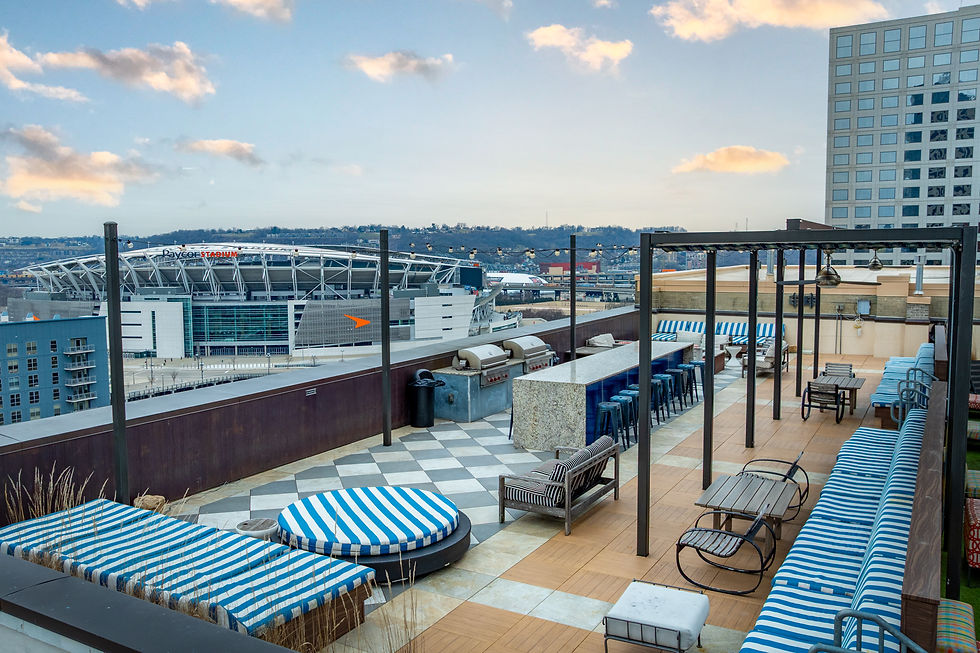
The rooftop is this building's best kept secret. You'll have a hard time finding a better view of PayCor Stadium, Great American Ballpark, and The Roebling Bridge.
The story of the Union Central Annex reflects the story of Cincinnati. Since the first stone was set, the annex has stood with the city through its highest highs and lowest lows. From hosting the city’s most vital banking and insurance industries to housing Cincinnati’s residents in luxurious fashion, the Union Central Annex is a cornerstone of Cincinnati’s history and a pivotal part of its future.


Comments